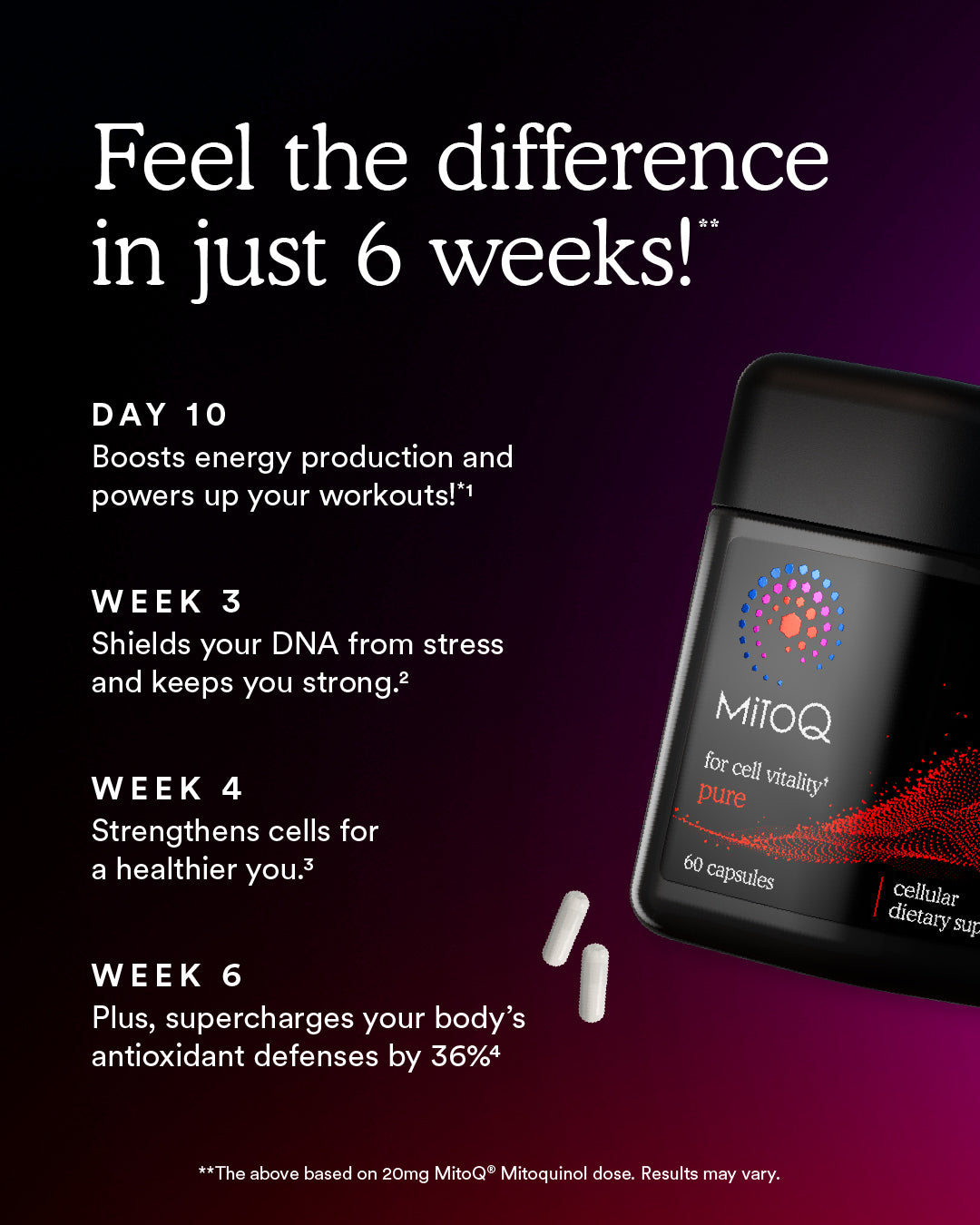
What if feeling older starts with how your cells make energy?
Slower recovery, lower energy, and reduced resilience are often blamed on age.
But as discussed on Health Uncensored with Dr. Drew, these changes may start deeper — inside your mitochondria, the energy centers of your cells.
SUBSCRIBE AND SAVE UP TO 30% use code PURE10 at checkout

Your energy doesn’t start with caffeine. It starts with your cells.
Mitochondria help produce ATP — the energy your cells use to function. When they’re working well, energy production is more efficient. But when they’re under strain, energy, recovery, and resilience can start to feel less reliable.
This is why aging is often felt first as:
- Slower recovery
- Lower resilience
- Reduced day‑to‑day energy
The hidden challenge: oxidative stress
Producing energy isn’t a clean process.
Each time your cells make energy, they generate by‑products — like exhaust from an engine. This is known as oxidative stress.
As that stress builds up inside mitochondria, efficiency drops and output becomes harder to sustain.
Dr Mitchell, neuroscientist: “Think of mitochondria as engines… but at the same time, they’re making this exhaust — and that’s oxidative stress.”
Supporting mitochondria means addressing this stress at the source — inside the cell.
The key insight: most supplements don’t reach the source
Many people turn to stimulants or general antioxidants when energy dips. Others reach for CoQ10, a well‑known compound involved in cellular energy.
The challenge?
Conventional CoQ10 struggles to reach the mitochondria — where it’s actually needed.
MitoQ Pure was designed to solve that problem.
MitoQ Pure: designed for mitochondria
MitoQ Pure was developed using advanced research to create a mitochondria‑targeted form of CoQ10.
Taken daily, MitoQ Pure supports:
- More consistent day‑to‑day energy
- Faster recovery from physical and mental strain
- Greater resilience as the body changes with age
- Energy production that doesn’t rely on stimulants
This targeted design is why MitoQ has been studied in areas like healthy aging, vascular function, and exercise performance.
Why MitoQ Pure was featured on Dr Drew
It stood out as a solution aimed at the foundation — not quick fixes.
- Goes beyond surface‑level energy solutions
- Focuses on root causes, not symptoms
- Backed by human research
- Addresses aging, recovery, and resilience at the cellular level
“You can’t out‑train poor recovery."
As featured on the show, celebrity strength and conditioning coach, Gunnar Peterson, explains why recovery changes with age.
“You can’t out‑train poor recovery. If you want to perform well as you age, you have to support your cells — not just your workouts.”
After learning about MitoQ’s research, he made it part of his routine.
“I didn’t notice it after one dose. I noticed it when I stopped — and then started again.”
“That’s when I knew it was doing something.”
Real stories, real results
-
View product
“From day one, much to my surprise, I felt a clean lift in energy, without the jittery caffeine feel. I have calm, steady focus all day.”
~ ENERES -
View product
“Can feel the difference in energy levels (no dips in the afternoon) and my overall wellness level."
~ KENNETH T -
View product
“It has become a staple in my protocol! I highly recommend it!”
~ PETER
SUBSCRIBE AND SAVE UP TO 30% use code PURE10 at checkout

Still have questions? We've got answers
What is the difference between Mitoquinol and Mitoquinone?
Yes, Mitoquinone and Mitoquinol are basically the same. Similar to many other antioxidant supplements, our supplement can exist as two forms, a reduced form, Mitoquinol, or an oxidized form, Mitoquinone. Once inside the body Mitoquinol can be oxidized to Mitoquinone and then recycled back to Mitoquinol as it performs its antioxidant function. When you see Mitoquinone referred to in a scientific article rest assured they are talking about our molecule. Mitoquinone and Mitoquinol are basically bio-equivalent inside the cell. We supply the Mitoquinol form since it is easier for use in capsule (easier to use as a powder).
When should I take MitoQ?
We recommend that you take MitoQ in the morning on an empty stomach, at least 30 minutes before your first meal of the day. You can take MitoQ 2 hours after eating. MitoQ is water-soluble, so it doesn't need to be taken with food or oils to assist with absorption.
What can I expect?
Everyone will experience MitoQ differently, depending on your age, your fitness, your overall health. It can take days, weeks or months for you to experience support for energy levels and health.
Can I take MitoQ with other supplements?
MitoQ can be taken in combination with your other supplements. Some of our products do have vitamins and minerals in them, so it’s a good idea to keep an eye on your intake levels of those so that they stay within the recommended range.
What are the promotion terms and conditions?
More questions?
Find answers on our FAQs page.
Disclaimers
1 results of a clinical trial conducted with healthy middle-aged men n = 23
2 results of a clinical trial conducted with healthy men n = 24
3 results of a clinical trial conducted with healthy middle-aged men n = 19
4 results of a clinical trial conducted with healthy elderly men and women n = 20
5 results of a clinical trial conducted with healthy elderly men n = 19
† based on pre-clinical data.
** based on 20mg MitoQ® Mitoquinol dose. Results may vary.
Resources
1. Broome, S. C. et al. MitoQ supplementation augments acute exercise-induced increases in muscle PGC1α mRNA and improves training-induced increases in peak power independent of mitochondrial content and function in untrained middle-aged men. Redox Biol. 53, 102341 (2022).
2. Williamson, J., Hughes, C. M., Cobley, J. N. & Davison, G. W. The mitochondria-targeted antioxidant MitoQ, attenuates exercise-induced mitochondrial DNA damage. Redox Biol. 36, 101673 (2020).
3. Broome, S. C., Braakhuis, A. J., Mitchell, C. J. & Merry, T. L. Mitochondria-targeted antioxidant supplementation improves 8 km time trial performance in middle-aged trained male cyclists. J. Int. Soc. Sports Nutr. 18, 58 (2021).
4. Rossman, M. J. et al. Chronic Supplementation With a Mitochondrial Antioxidant (MitoQ) Improves Vascular Function in Healthy Older Adults. Hypertens. Dallas Tex 1979 71, 1056–1063 (2018).
5. Pham, T. et al. MitoQ and CoQ10 supplementation mildly suppresses skeletal muscle mitochondrial hydrogen peroxide levels without impacting mitochondrial function in middle-aged men. Eur. J. Appl. Physiol. 120, 1657–1669 (2020).
6. Bispham, N. Z. et al. MitoQ Supplementation Improves Leg-Extension Power in Healthy Late Middle-Aged and Older Adults. FASEB J. 31, lb852–lb852 (2017).